

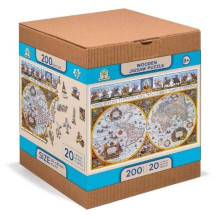
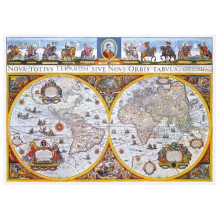
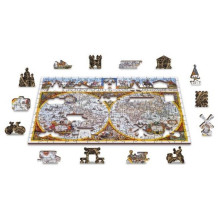
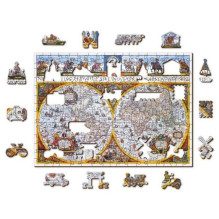

Wooden puzzle Map Nova Terrarum Antique 200
Wooden puzzle Map Nova Terrarum Antique 200
Guarantee
24 month
Delivery from Lithuania in
2 - 6
business days
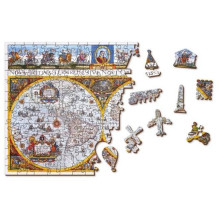
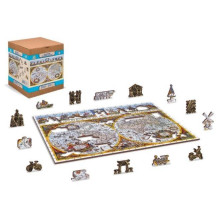
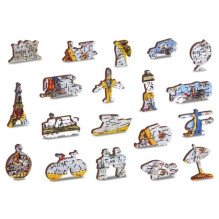
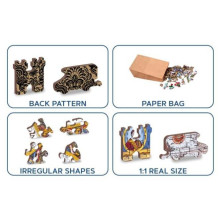
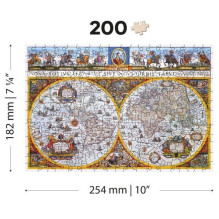
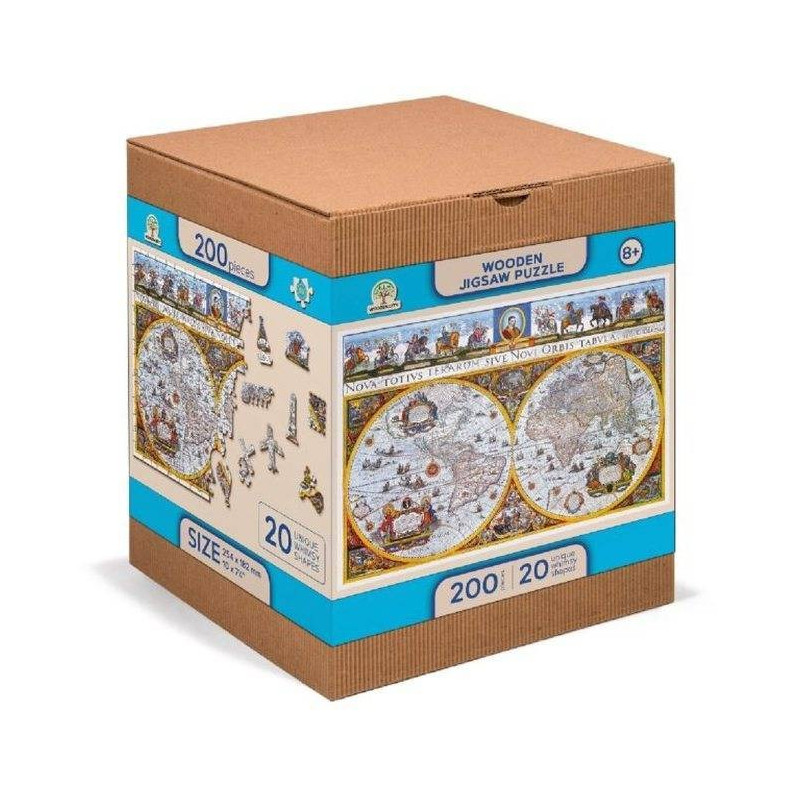
Who doesn't love a good puzzle? Puzzles are generally considered fun. Whether you're spending a night alone or going to a party with friends and family, you can always count on solving puzzles to be a truly unique and fun way to break the ice. Puzzles together are a fun way to promote communication and friendship. But it's also a great opportunity to develop logical thinking and test motor skills and memory! Are you ready for a unique theme and a new exciting challenge? Surprise everyone at game night with the new Wooden.City Map - Nova Terrarum Antique! Step into the Golden Renaissance with a stunning puzzle of an antique 17th century map. This 200-piece version is a complex image full of great illustrations, unique shapes and refined details. You'll spend hours exploring the intricacies of this historical work of art. Made in Poland by the carpentry company Wooden.City, where each product is made of durable, laser-cut birch plywood. You won't find old wood smells or sharp edges here. Each piece is smooth, rounded and sturdy, emitting a gentle wood scent. Wonderfully tactile details that are a pleasure to touch and play with. Our puzzles have been designed to delight people of all ages and interests. Take one home for your family or give it as a creative gift. Kill time or turn your ride into a race - the idea is that you should have fun!
Tested and certified: CE, EN-71, ASTM D-4236 Made from 100% child-safe materials Made in Poland Wooden City is a Polish brand originating from the city of Wrocław. It produces wooden models that can be assembled in the form of a puzzle, combining creativity and many years of experience with laser device technology. The components are made of certified birch wood, and each model is made with precision. Wooden puzzle Map Nova Terrarum Antique 200 Great geographical discoveries - geographical discoveries at the turn of the 15th and 16th centuries: Painting "Columbus Discovers America"
During this period, European ships sailed the world, looking for safer or faster trade routes, new trading partners, which promoted the spread of capitalism in Europe. Many new nations and peoples were discovered, more accurate maps were drawn, and many new lands were discovered. The most famous travelers were Christopher Columbus, Vasco da Gama, Pedro Álvarez Cabral, John Cabot, Yermak, Juan Ponce de León, Bartholomew Dias, Ferdinand Magellan, Willem Barentsz, Abel Tasman, Jacques Cartier, William Jansson, Captain James Cook, and many others whose contributions to geography are not so widely known. The idea of the age of geographical discoveries arose in the Renaissance, when new technologies began to spread. Cartography, navigation improved, better weapons and ships were created. The idea arose to find a way to Asia through the west. Important developments were the invention of carracks and caravels: these ships could sail not only in the relatively calm Mediterranean Sea, but also into the Atlantic Ocean. Such a map was drawn by the Moroccan Al-Idrisi in 1154, by order of King Roger of Sicily.
Marco Polo The Age of Discovery was ushered in by the Mongol invasion, which not only brought death but also opened up trade routes between Europe, the Middle East and China. Many Europeans, most of them Italians, took advantage of the situation. The first traveller was Giovanni de Plano Carpini, who travelled to Mongolia in 1244-1247. However, the most famous journey to the East was made by Marco Polo in 1271-1295; he described it on his return and attracted European attention. Unfortunately, overland travel was hampered by many obstacles: it was long and dangerous, travel was slowed by plague, and the rise of the Ottoman Empire, which restricted trade with the East.
. The map of the monk Fra Mauro, drawn in Venice in 1459, showed the outlines of Europe, Asia, and Africa. The main motives for geographical discoveries were the lack of gold and silver, which were used as money. One of the first major expeditions was sent by the Portuguese prince Henry the Navigator. This expedition sailed into the Atlantic Ocean and discovered the island of Madeira in 1419, and the Azores in 1427. Both islands became Portuguese colonies. Henry's goal was to explore the west coast of Africa, since the only trade routes leading to western Africa ran through the Sahara Desert, and these routes were controlled by the Muslim rivals of Portugal. In 1434, Cape Boyador was rounded, and a few decades later, the Sahara was crossed and trade relations were established with the people living in present-day Senegal. The Portuguese continued to establish trading colonies. 1482 Diego Cao's expedition encountered the Kingdom of Kongo. 1488 Bartolomeu Dias rounded the Cape of Good Hope and proved that a sea route to India was possible. 1498 Vasco da Gama took advantage of Bartolomeu Dias' discovery and was the first to reach India by sea.
- the ship on which Christopher Columbus sailed (drawn) Andries van Eertvelt in 1628). Portugal's rival Spain was slower in exploration until the late 15th century, when Spain and Portugal competed for influence in the Canary Islands, which Spain gained. In 1492, Queen Isabella I of Castile supported Christopher Columbus (an expedition consisting of three ships was organized Nina, Braided and Santa Maria ), in order to bypass Portugal by sailing to India through the west. But Columbus did not reach Asia, but discovered the "New World" - America. In 1500, the Portuguese Pedro Álvarez Cabral discovered Brazil. The resulting land dispute was resolved by the Pope, who divided the spheres of influence by giving Portugal: Africa, Asia and South America. Spain received the rest of the unknown world, the islands of the Pacific Ocean and the rest of America. The Spanish travelers were disappointed with what they found, because the islands did not have abundant resources, but when they discovered that there were powerful and wealthy empires on the continent, the islands served as colonial points from which the conquistadors set out to attack the empires. The most famous were the Aztecs (conquered in 1521) and the Incas (conquered in 1532). After the Spanish conquests, the main goal was to obtain gold and silver and take them to Spain. In 1519, the same year that Cortes' army landed in the lands of the Aztec Empire, Spain supported the Portuguese Ferdinand Magellan. The mission's goal was to find the Spice Islands by sailing west. The three-year expedition was successful and became the first to circumnavigate the globe.
Portuguese expansion and colonization continued, despite Spanish competition. The Portuguese were the first Westerners to trade with Japan. Under King Manuel I, a number of forts were built to guard the main trade routes. Portugal was not prepared for such a shortage of manpower and money, so the forts were gradually taken over by other maritime powers that had ignored the Papal Partition of the World. Portuguese hegemony was broken up by the efforts of the French, English, and Dutch. In 1580, King Philip II of Spain became King of Portugal, as he was the grandson of Manuel I.
Nations beyond the Iberian Peninsula refused to submit to the division of the world. France, the Netherlands, and England also had maritime experience. Despite hiding technology and maps, they still reached the north. The first mission, sponsored by John Cabot in 1497, was to explore North America, which was not highly regarded by Spain, and was less populated and had fewer resources. In 1525, Giovanni de Verrazano became the first known European to reach the eastern part of the present-day United States. The goal of Cabot's voyage was to reach Asia by bypassing the Americas by the north, led by Jacques Cartier (the first voyage was in 1534, of three in total), although he failed to do so, his voyages facilitated the colonization of North America. Northern European nations also rivaled Portugal and Spain on the coasts of Africa and India. Dutch and British explorers sailed to "deserted" places. Willem Jansson and Abel Tasman explored the shores of Australia and discovered the island of Tasmania, and in the 18th century, British explorer James Cook discovered Polynesia.
. "Yermak Conquers Siberia" by Vasily Surikov. In 1552, Tsar Ivan IV the Terrible conquered the Kazan Khanate, which allowed for further exploration and conquest of the East. In 1580, Yermak entered Siberia with a crew of 1,636 men. Yermak slightly increased the possessions of Tsarist Russia, but in 1584 he drowned in the Irtysh, and his Cossacks abandoned Siberia. But this did not stop Russia's interest in Siberia, and after 80 years, Russian possessions reached the Amur and the Pacific Ocean.
The end of the Age of Discovery is considered to be the beginning of the 17th century. At that time, European ships could reach almost any place in the world. Exploration, of course, continued. The Arctic and Antarctica were not discovered until the 19th century, and the colonization of the interior of the continents (North America, Africa) also took a long time.
The consequences of the period were unprecedented. For millennia, the Mediterranean economy had been the dominant economy, and the countries that controlled it controlled all of Europe. But now, as trade moved to the Atlantic and Indian Oceans, Spain, Portugal, and later Britain, the Netherlands, and France became the leading countries. Meanwhile, the importance of important trading cities such as Genoa and Venice declined. Maritime trade routes also ended the prosperity of the Silk Road. The era of geographical discoveries was followed by the Commercial Revolution, as transoceanic travel became commonplace, and merchants and traders became the main class. This led to the rise of the bourgeoisie. New plants (potatoes, cocoa, corn, tobacco, sugar cane) were brought to Europe from America, and domestic animals (horses, sheep, pigs, goats, oxen) were brought from Europe. Favorable conditions were created for the spread of Christianity and European culture. The development of geography and other sciences accelerated, communication between nations became wider and more open. Meanwhile, the conquest of Siberia allowed Russia to become one of the greatest powers in Europe and the world. There were also negative consequences - the value of money fell, diseases brought by Europeans and cruel treatment of the indigenous peoples of America, Asia and Africa destroyed their culture, hindered economic development. However, this gave them new historical opportunities. You can find all our puzzles here. You can find our other globes and maps here.

