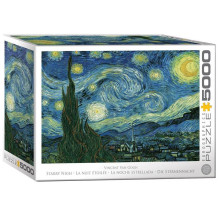
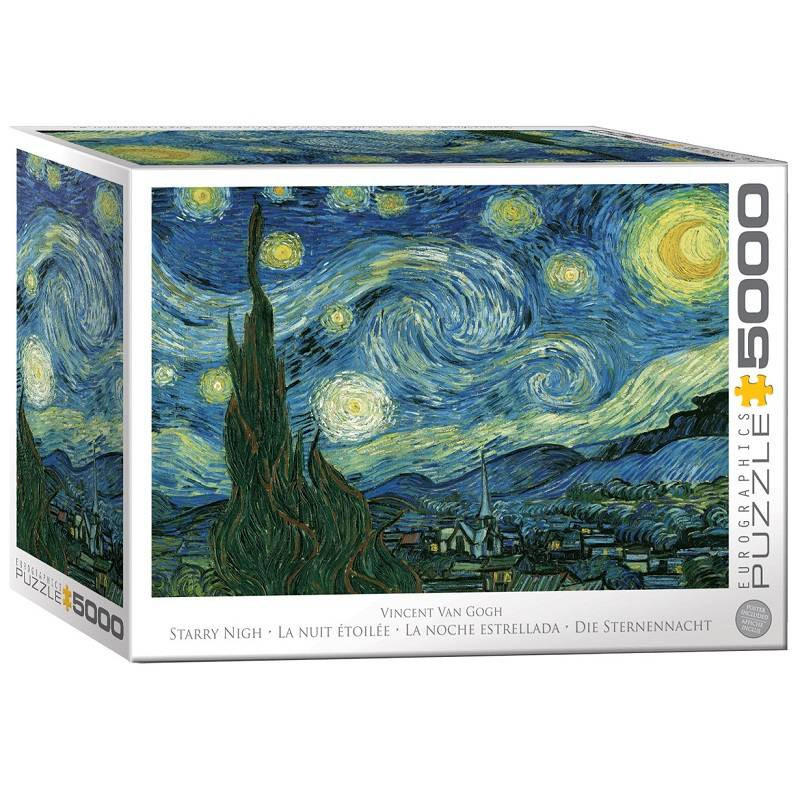
Puzzle Starry Night Vincent van Gogh (Vincent van Gogh) 5000 pieces
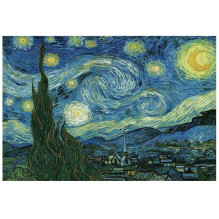
This painting is considered one of Van Gogh's best works and is one of the most recognized in the history of Western culture. Vincent van Gogh's early work is characterized by images of the lives of poor people (for example, the paintings "Portrait of a Peasant Woman" or "Potato Eaters"). He painted a number of landscapes and still lifes. These paintings by Vincent van Gogh are realistic, with dark colors. Van Gogh's work of this period was influenced by F. Mille, JH Mariso, A. Mauve. The artist signed his works only with his name Vincent. An important source of Vincent van Gogh's work is nature. The goal of his work is to convey the essence of objects and phenomena with colors and expressive strokes, to immortalize not what happens, but what is typical. He painted and modeled forms with colors, created rhythm, defined proportions and spatial relationships. Sometimes large color areas are outlined with a lively, restless contour. In the artist's late works, the beauty of nature acquires a certain menace, sadness, although the color scheme remains expressive. An expressive deformation of forms appears, strengthening the mood of drama. The work is characterized by a synthesis of color and drawing, expressively distorted forms, red, purple, rich yellow colors prevail - they have a symbolic meaning, express inner anxiety (e.g., " Starry night ", "Portrait of Doctor Gachet", "Wheat Field with Crows"). His famous works, depicting a chair, a pair of shoes, a cornfield and crows, show that everyday, familiar and ordinary objects can be "elevated" to the level of symbols and internal tension, and that form can become eloquent under the influence of emotion. The expressionists later turned in this direction. Vincent van Gogh created more than 800 canvases and 1,100 drawings, but only one painting - "The Red Vineyards of Arles" - was sold while he was alive.
Notable works
- The Potato Eaters (1885)
- Night Café (1888)
- Starry Night over the Rhone (1888)
- The Red Vineyards of Arles (1888)
- Sunflowers (1888-1889)
- Bedroom in Arles (1888)
- Self-portrait with bandaged ear (1889)
- Starry Night (1889)
Creative peak and death in France
On March 1, 1886, Vincent van Gogh arrived in Paris.
He lived with his brother Teo in Montmartre and studied in the studio of the academic artist Fernand Cormon. There he met A. de Toulouse-Lautrec, L. Anquetin and E. Bernard. The latter introduced him to the Parisian art of that time: impressionism, neo-impressionism, cloisonnism. Vincent met P. Gauguin, whose paintings were sold by Vincent's brother Teo. In Paris, Vincent van Gogh's palette brightened, he tried various stylistic solutions, painted brightly colored cityscapes, landscapes, and portraits. These works are marked by the influence of the Impressionists, P. Cézanne's work, and Japanese woodcuts. Vincent hoped to earn money by painting portraits and practiced painting himself in the mirror. In Paris, Vincent created at least 24 of his 47 self-portraits and the first "Sunflowers" paintings. His friend tapo art and art supplies seller "dad" Tangi, who exhibited Van Gogh's paintings in his shop; the artist painted his portrait. Vincent van Gogh, painted in pastel by Henri de Toulouse-Lautrec, 1886. Vincent van Gogh discovered the main means of artistic expression - bright, extremely bright colors - only in February 1888, after moving to live in a small town in southern France, Arles, where his most mature creative period began. In about 15 months (444 days), the artist created 200 oil paintings and more than 100 drawings. This was the most mature, but short period of the highest creative rise. The colors of his paintings tapo are expressive and intense, the dots, lines, and strokes used created a painting image close to graphics. Why Van Gogh went to Arles remains unclear. During the winter he was ill in Paris, living together with his brother Teo was stressful, and Vincent hoped that the light and landscape of southern France would be close to the images of his favorite Japanese prints. Kai On February 20, 1888, Vincent arrived in Arles, a snowstorm raged in the city. When spring came, the artist painted 14 images of flowering trees. In June, he visited the seaside in southern France, at which time the features of impressionist art disappeared in his painting, giving way to Van Gogh's personal style. The artist became friends with the postman Joseph Roullen. He painted many portraits of the postman and his family. On September 18, 1888, Vincent moved into the "yellow house" on the Place Lamartine. He cherished the hope that this residence would become the center of a new artists' colony, the leader of which he saw P. Gauguin. His brother Teo agreed that he would pay for P. Gauguin's life in Arles for several paintings. Paul Gauguin arrived in Arles on October 23, 1888. He settled with Van Gogh in the "yellow house" and at first the artists got along, but later the differences between their personalities, attitudes to art, and painting methods began to become apparent. P. Gauguin hated Arles and did not hide that he was not going to stay there for a long time. In his work, P. Gauguin used painting from memory, imagination, and forced Van Gogh to paint in the same way, mocking him for being dependent on having an object for painting before akis. The artists' relationship deteriorated further. In mid-December, Gauguin gave Van Gogh a portrait of him, which depicted Vincent painting sunflowers. According to legend, Van Gogh described the painting with the words: "It's really me, only crazy." After that, Van Gogh threw a glass of absinthe at Gauguin's head in a bar. The artists apparently reconciled, but, according to Gauguin, on December 23, he went for a walk after dinner and felt that he was being followed. Turning around, he saw Vincent with a razor in his hand. Unable to withstand Gauguin's gaze, Vincent turned and left. Gauguin did not dare to return to the "yellow house" and spent the night in a hotel. In the morning, he was met by police officers and city onlookers in the "yellow house". Vincent was taken to the Arles hospital. The evening before, he had cut off part of his left ear and, having gone to a brothel, gave it to the prostitute Rachel for "safekeeping". Mr. Gauguin reported the events by telegram to Vincent's brother Teo, who arrived in Arles for one day and on December 27 left for Paris with Mr. Gauguin. Vincent was discharged from the hospital on January 7, 1889, diagnosed with epilepsy, and returned to the "yellow house". He was increasingly lonely, his friend the postman Joseph Roulin left for a new position in Marseille, and on February 4, Vincent was again hospitalized for a poisoning persecution mania. There, voices were heard and hallucinations appeared. After 10 days, the painter was discharged. Neighbors feared him, the police forbade him from returning to the "yellow house", and several townspeople signed a petition demanding that the artist be imprisoned or moved out of the city. On February 25, he was hospitalized again. At the end of March, Vincent's health improved. Paul Signac visited him, and together they returned to the "yellow house", which rado had not been ransacked. Vincent began to paint again. After these events, Vincent continued to correspond with P. Gauguin, but the artists never met again. Van Gogh found it difficult to endure loneliness and, after consulting with a local clergyman, decided to move to the St. Paul psychiatric hospital, located in an ancient monastery in the nearby town of Saint-Rémy-de-Provence. On May 8, 1889, he arrived in Saint-Rémy-de-Provence and stayed in the hospital for about 1 year. The first work created there was "Irises" - a painting that stands out among all the flower images created by Vincent. The lonely white flower in it can be treated as a personification of the artist. In the works of the Saint-Remy period, the artist filled the space of the painting with objects, avoiding emptiness. Even the individual strokes of the painted sky form a whole of objects, "bricks". The artist painted a hospital, self-portraits, and when jam was allowed to leave - cypresses, olive trees and a nearby quarry. He also returned to older works: he painted versions of "The Bedroom at Arles" and created the painting "At the Gates of Eternity" in a new style, based on a lithograph published in 1882. He also copied the works of other artists: O. Daumier, Rembrandt, Delacroix, F. Mille, G. Dore. Vincent de Saint-Remi experienced periods of calm, interrupted by bouts of illness. He created one of his most famous paintings, "The Starry Night". In September 1889, 11 of his paintings were exhibited at the Paris Exhibition of the Society of Independent Artists and were noticed by Teo critics. The Dutch critic JJ Isaäcson published an enthusiastic article about his work in the Dutch press. In January 1890, Van Gogh's works were included in the exhibition of the Society of Les XX in Brussels. The French critic Albert Aurier published the first essay on the artist's work in the magazine Mercure de France. On January 31, 1890, a son was born to the brother Teo and his wife Johanna, whom they named Vincent Willem. In March, the painting "The Red Vineyards of Arles" was sold in Brussels for 400 francs, which is considered the only one sold while Van Gogh was alive. On May 16, 1890, after his health improved, Vincent left the Saint-Rémy hospital, where he had created 150 paintings, and went to Paris, where he spent three days with his brother's family. The noise of Paris bothered him, and on May 20, the artist moved to the village of Auvers-sur-Oise, where he was cared for by Dr. Paul Gachet, himself an amateur painter and an acquaintance of C. Pissarro and P. Cézanne. However, the illness did not leave the painter, and on July 27, 1890, he went out into the fields with an easel as if to paint and shot himself in the chest. The wounded Van Gogh crawled to an inn, where he was rado by Dr. Gachet. The artist died in 1890. July 29, 1891. It is likely that the wound was not fatal, and the main cause of death was infection from an unremoved bullet. In Auvers, Van Gogh created 70 canvases. Broken by the death of his brother, Teo van Gogh, whose health was already not very good, died six months later on January 25, 1891. Teo was initially buried in Utrecht, in 1914 his remains were reburied in Auvers next to Vincent.
Enjoy "The Starry Night" here in 5000 piece jigsaw puzzle form from Eurographs. Step into the dazzling world of Vincent van Gogh with the Eurographs "Starry Night" jigsaw puzzle. Measuring an impressive 97.00 x 68.00 cm, the puzzle is a masterpiece in itself. With 5000 intricate pieces, it offers a challenge that will captivate puzzle enthusiasts of all ages. kai Assembling this puzzle is like stepping into the mind of the artist, recreating his iconic work of contemporary and modern art. Whether you are a puzzle fan or a lover of van Gogh's art, the "Starry Night" jigsaw puzzle is an essential addition to your collection. Immerse yourself in the beauty of this timeless masterpiece and bring it to life piece by piece.
The puzzle is made of the highest quality European recycled blue cardboard paper and printed with vegetable ink.
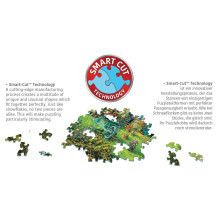
Smart-Cut™ technology This premium puzzle will delight and educate everyone at the same time
Whether you are a beginner or an experienced puzzle collector, this puzzle will provide hours of entertainment and relaxation. Puzzle Starry Night Vincent van Gogh (Vincent van Gogh) total number of pieces: 5000 Puzzle Starry Night Vincent van Gogh (Vincent van Gogh) 5000 assembled dimensions: 97.00 x 68.00 cm Box size: 30.50 x 25.40 x 7.50 cm Age: 8-108+ You can find all our puzzles here. If you are looking for unique globes and maps, visit our other el store www.gaubliai.lt.