



Puzzle Gallery of Modern Rome Images. Giovanni Panini 1000
Puzzle Gallery of Modern Rome Images. Giovanni Panini 1000
Guarantee
24 month
Delivery from Lithuania in
2 - 6
business days
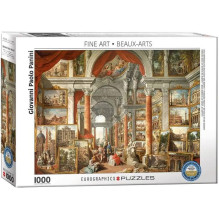
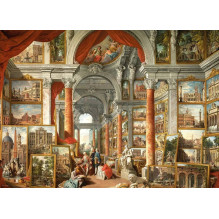
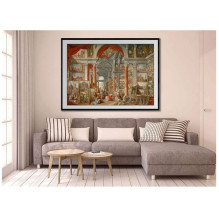
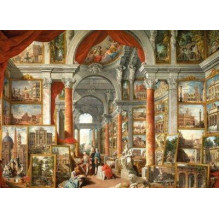
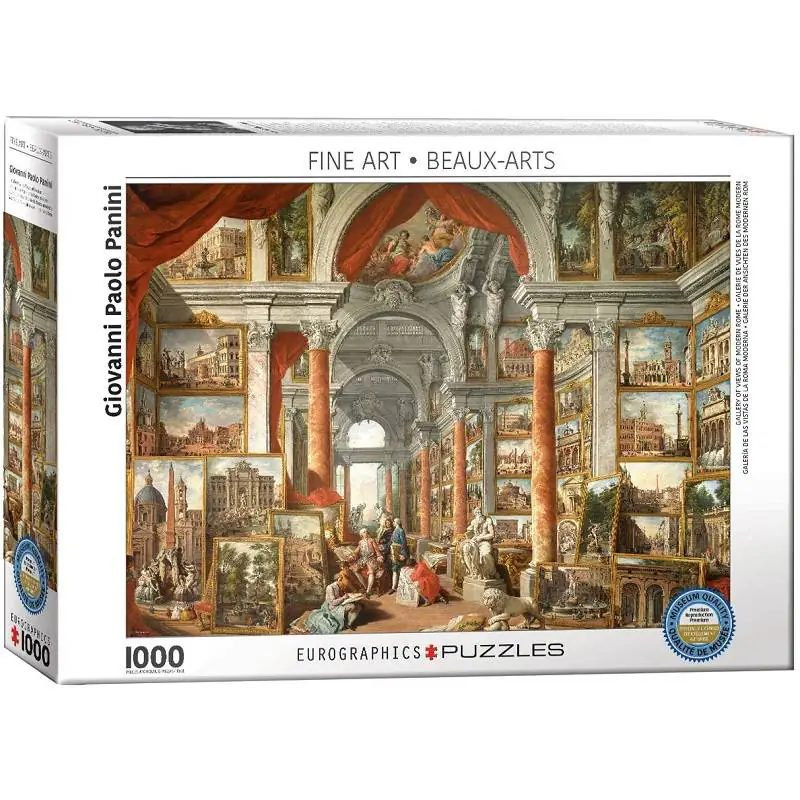
Inspire the grandeur of Rome with the "Eurographics" 1000-piece puzzle Gallery of Modern Rome, featuring the exceptional art of Giovanni Paolo Panini. This intricate masterpiece captures the grandeur of 18th-century Rome, complete with majestic columns, stunning architectural monuments, and richly detailed cityscapes, all framed in a luxurious gallery setting. The Gallery of Modern Rome, known simply as Modern Rome, is a collection of nearly identical paintings by Italian artist Giovanni Paolo Panini, painted in 1750-aisiais. The original painting depicts an arrangement of paintings originally commissioned by Étienne François, Count of Stainville, later Duke of Choiseul. He was ambassador to Rome from 1753 to 1757. Stainville is seated in an armchair in the painting. Panini created three different versions of this painting. He created two versions of the painting, both dated 1757, for the Count of Stainville - the original is in the Museum of Fine Arts, Boston, and the second is in the Metropolitan Museum of Art in New York. A couple of years later, he created a slightly different version of this painting for Claude-François de Montboissier de Canillac de Beaufort [fr], which now hangs in the Louvre in Paris. The picture gallery contains many paintings depicting buildings, monuments, and sculptures in Rome at the time kai Panini painted it. On the left side of this work, among others ko, are paintings of St. Peter's Basilica, Trevi the fountain, and the Spanish Steps. On the right side, among others ko, are paintings of the church of Santa Maria Maggiore, Piazza Navona, and the Villa Aldobrandini. In the middle are four statues, arranged from front to back: the Medici Lion, Michelangelo's Moses, Bernini's David, and Bernini's Apollo and Daphne. The painting is a pendant to the painting "Ancient Rome" by Panini. The Metropolitan Museum of Art and the Louvre have versions of both paintings, "Modern Rome" and "Ancient Rome." A third version of "Ancient Rome" is held by the Stuttgart State Gallery. Giovanni Paolo, also known as Gian Paolo Panini or Pannini (17 June 1691 – 21 October 1765), was an Italian Baroque painter and architect who worked in Rome and is primarily known as one of the vedutists. As a painter, Panini is best known for his depictions of Rome, in which he was particularly interested in the city's antiquity. Among his most famous works are the interior of the Pantheon (under the name Francesco Algarotti) and the veduta, picture gallery paintings of Rome. Most of his works, especially those of ruins, are characterized by the elaborate and unrealistic decoration typical of capriccio themes. In this respect, they resemble the capriccios of Marco Ricci. Panini also painted portraits, including a portrait of Pope Benedict XIV. Panini worked in the studio of Hubert Robert and his son Francesco Panini. His style influenced other vedutists, such as his students Antonio Joli and Charles-Louis Clérisseau, as well as Canaletto and Bernardo Bellotto, who sought to satisfy the demand for painted "postcards" depicting the Italian countryside. Kai British landscape painters such as Marlow, Skelton and Wright of Derby also imitated his capriccios. In addition to being a painter and architect, Panini was a professor of perspective and optics at the French Academy in Rome. His masterful use of perspective later inspired the creation of the "Panini projection", which is very important for the rendering of panoramic images. In his youth, Panini studied in his native city of Piacenza with Giuseppe Natali and Andrea Galluzzi and with the set designer Francesco Galli-Bibiena. In 1711 he moved to Rome, where he studied drawing with Benedetto Luti. In 1724 he married Mademoiselle Gossert, sister-in-law of Wengkels, director of the French Academy in Rome, with whom he had two sons: the architect Giuseppe Pannini (Rome, 1720-1812) and the painter Francesco Panini (Rome, 1745-1812), who followed in his father's footsteps and manners. In Rome, Panini became famous as a palace decorator. His works include the Villa Patrizi (1719-1725), the Palazzo de Carolis (1720) and the Seminario Romano (1721-1722). In 1719, Panini was admitted to the Congregation of the Virtuosi of the Pantheon (Congregazione dei Virtuosi al Pantheon). He taught in Rome, at the Accademia di San Luca (Accademia di San Luca) and the Académie de France, where he is said to have been influenced by Jean-Honoré Fragonard. In 1754, he served as Prince (Director) of the Académie Saint-Luc. The Spanish monarchs appreciated his work so much that, at the behest of Filippo Juvarra, he sent paintings to decorate the Lacquer Room of the Royal Palace of La Granja de San Ildefonso. In addition, King Carlos IV, as a prince, purchased several of his works, which are still preserved in the Prado Museum and the Royal Palace. Panini died in Rome on October 21, 1765.
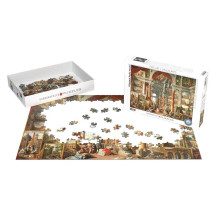
Ideal for art enthusiasts, history buffs or anyone who enjoys a creative challenge, this puzzle is a tribute to Rome's rich heritage and timeless beauty. Discover the joy of assembling a piece of history! The Modern Rome Gallery puzzle is made of high-quality materials and equipped with the innovative "Smart-Cut" technology, which ensures precise placement and a pleasant layout of the puzzle. The puzzle is made of the highest quality European recycled blue cardboard paper and printed with vegetable ink.
Smart-Cut™ technology This premium puzzle will delight and educate everyone at the same time
Whether you are a beginner or an experienced puzzle collector, this puzzle will provide hours of entertainment and relaxation.
Assembled puzzle dimensions: 48.9cm x 67.6cm Box size: 25x36x6cm Age: 8-108+ Warning: Not suitable for children under 3 years old, many small parts, plastic packaging, choking hazard. Country of origin: Canada Made in: Canada You can find all our puzzles here. If you are looking for unique globes and maps, visit our other el store www.gaubliai.lt.