

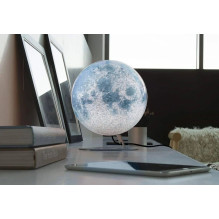
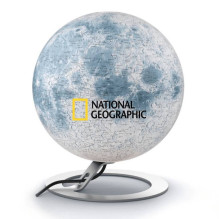

Globe-lamp MOON 30 cm National Geographic
Globe-lamp MOON 30 cm National Geographic
Guarantee
24 month
Delivery from Lithuania in
2 - 6
business days
Globe-lamp MOON 30 cm National Geographic
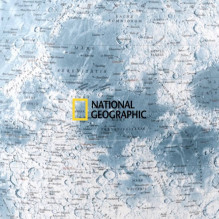
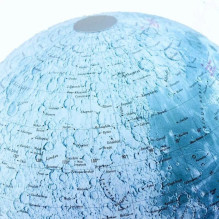
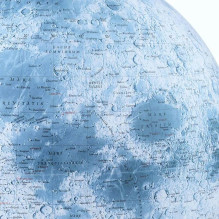
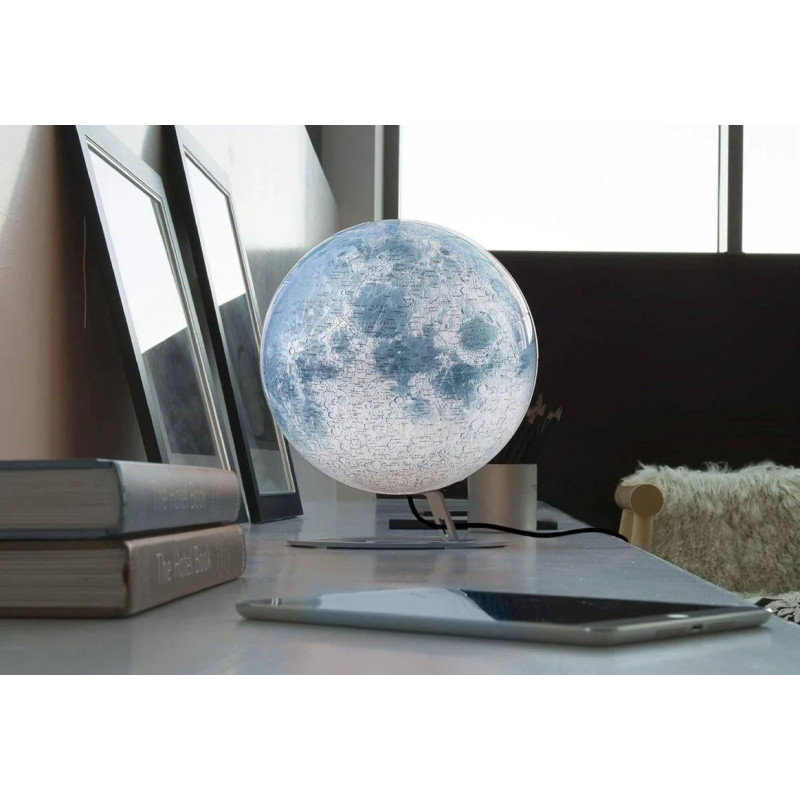
Globe-lamp MOON 30 cm: one of the most modern globes ever seen with a real and extremely detailed lunar map. All craters, locations and their names are indicated. Globe-lamp MOON 30 cm has an Aluminum base, which provides maximum stability and modernity. Globe-lamp MOON 30 cm - A great interior detail. Globe-lamp MOON 30 cm is with LED lighting 30cm Moon surface map "National Geographic" cartography Globe-lamp MOON 30 cm National Geographic ————- The Moon - the only Earth natural satellite and the closest cosmic body to it. The Moon is 1.3 light seconds. Second in brightness (after Solar ) cosmic body. Dark spots and smooth lower areas visible to the naked eye on the bright disk of the Moon; they are called by seas. The bright areas are highlands and are called continents. These names are conditional, because there is not a large amount of water on the surface of the Moon. Both the seas and the continents have a lot of craters. The visible side of the Moon has more plains than the dark side. It is the only one, apart from Earth, Solar systems the body in which a person has been - him 1968 - 1972 visited " Apollo "spacecraft, 12 astronauts have landed on the Moon. "Moons" can also be called natural satellites of other planets satellites, but for convenience, this article only discusses Earth's satellite - the Moon. Moon movement Moon librations and phases animation of the phases of the moon: new moon ⚫, crescent moon ◐, full moon ⚪, waxing gibbous ◑ (as viewed from Earth) northern hemisphere, from southern hemisphere would be respectively ⚫◑⚪◐) The Moon orbits the Earth in an elliptical orbit orbit, so it is not at the same distance from it. It comes closest to 363,300 km, and is farthest from it to 405,500 km. The Moon orbits the Earth in the same direction as it rotates on its axis. Because of its slower orbit, to an observer on Earth, the Moon appears to move from east to west across the sky at night, but it is slowly moving from west to east relative to the stars. It is believed that the Moon formed about 12 to 19 times closer to the Earth than it is now, and has been slowly moving away from it since then (3.78 cm per year). As it moves around Earth The moon depending on Solar The illumination is always different - it is full, it is just a crescent looking in one direction or the other - you can see different aspects of the Moon. phase The attached image shows all Moon phases A full lunar cycle lasts 29.5 days. Surface The first telescopic maps of the Moon were made in 1609. The first to draw a drawing of the Moon with many recognizable details was made by Thomas Harriot (1560-1621). The Moon was studied more extensively and systematically from 1610 onwards by Galileo, describing in detail the mountains, craters and gray plains. The latter were called seas. This name is symbolic. The names of those seas are written in Latin, for example, Sea of clouds - Mare Nubium, Clear sea - Mare Serenitatis, Sea of Islands - Mare Insularus, Ocean of Storms - Oceanus Storms. Seas cover about 40% of the visible side of the Moon. The Moon is very heavily cratered. Their size varies from huge cirques with a diameter of 240 km to small pits that cannot be seen from the ground. Earth. A characteristic feature of a crater is a ridge that rises slightly above the surrounding area. The bottom of the crater is concave, and a mountain or group of them may stand in its center. The ridges of some craters, compared to the deepest parts of the bottom, rise by 3000 m or more. The origin of craters has long been debated. The most important disagreements arose over the following questions: whether the craters appeared under the influence of external forces (falling meteorites) or whether they were created by internal forces of the Moon (volcanic eruptions). Undoubtedly, the Moon, like the Earth, has both types of craters. Some lunar seas resemble regular craters: they are circular and surrounded by mountains on all sides. For example, a huge A sea of rain ( Mare Imbrium ) is surrounded by the Apennines, the Carpathians, and the Alps. These mountains are discontinuous, with wide gaps in places. The Apennines are the most impressive of the entire range. Their majestic peaks are as high as 4,570 m. Other features on the Moon's surface include rounded hills, domes with one or more craters at the top and sloping slopes, occasional spurs, and many fault-like features called faults, valleys, or simply furrows. Some of these features can be seen through amateur observation devices. Lava tunnels Partially collapsed 50 km long lava tunnel Underground lava tunnels have been found on the Moon, which appeared like similar tunnels on Earth: flowing basalt lava first solidified on the surface, then the still liquid lava inside subsided, forming voids. Due to lower gravity and the absence of an atmosphere, the lava tunnels on the moon are much larger, their length reaches tens of kilometers. These tunnels are a possible location for human colonies on the moon: they are protected from cosmic radiation, the tunnels have a constant and not very extreme (-20 °C) temperature. Northern Hemisphere On the Earth-facing side of the Moon, in the northern hemisphere, lie two large seas - Rainy ( Mare Imbrium ) and Clear ( Mare Serenitatis ). They are both circular, but appear slightly elliptical due to their projection onto the lunar disk. The Ligurian Sea is surrounded on almost all sides by mountains, including the majestic Apennines with peaks up to 4,570 m high. There is a gap between the Apennines and the much lower Caucasus Mountains, connecting the Ligurian Sea with the Giedros. The Alps are crossed by a 95 km diameter Plato's Crater with a dark bottom. There are several large craters on the plain of the Litai Sea. These are 80 km in diameter Archimedes Crater and two smaller but deeper neighbors - the craters Aristil and Autolycus. There are no such large craters in the Clear Sea, the largest - the Bessel crater with a diameter of only 39 km. The Clear Sea connects to the south with Sea of Tranquility ( Mare Tranquillitatis ), which is apparently older and less regular in shape. It is to this sea that 1969 m. July. landed " Apollo 11 " astronauts. Then humans first visited the Moon. Near the eastern edge of the lunar disk lies A sea of crises ( Mare Crisium ). It is smaller, but easily visible even to the naked eye. The largest plain in the Northern Hemisphere is Ocean of Storms ( Oceanus Storms ), which is separated from the Sea of Rain by the relatively small Carpathian Mountains. Located in the Ocean of Storms Aristarchus Crater The crater is one of the brightest on the Moon, as it is illuminated by light reflected from the Earth. Therefore, this crater is often visible even on the dark side of the terminator. South of the Carpathian Mountains, it is bathed in bright rays Copernicus crater. Southern Hemisphere Lunar crater group: 1 − Ptolemy, 2 − Alphonsus, 3 − Alpetragius, 4 − Arzachelius A little south of the Moon equator big bricks plains areas, among which stand out Ptolemy Crater, with a diameter of almost 160 km, the bottom is relatively flat and dark. It is bordered by a much smaller Alfonso Crater with a mountain range and a system of faults at the bottom. In 1958, the Soviet astronomer N. Kozyrev observed a reddish glow in the Alfonso crater, indicating the instability of the Moon. In Kozyrev's opinion, this is evidence of the Moon's geological activity - volcanic activity. The third is Arzachel Crater, smaller but deeper than Alfonso, with a high hill in the center. The southern part of the moon is dominated by mountainous areas, but there are also several seas. This Sea of clouds ( Mare Nubium ) and smaller than it A sea of moisture ( Mare Humorum ). In the western part of the Sea of Clouds, near the Arzachel crater, there is Straight wall ( Rupes Recta ). This is the largest lunar surface trigger, which is 130 km long and about 240 m high. Among other ring formations, it is worth noting Shikardo Crater (in the southwest) with a dark bottom and a diameter of 230 km Clavius Crater (south), at the bottom of which a series of smaller craters are visible. North of the Southern Mountains is Tycho Crater, sometimes called the metropolis of the Moon because of its system of bright long rays. As the full moon approaches, Tycho dominates the entire hemisphere, outshining even the large surrounding craters. Tycho Crater is 86 km in diameter, with massive slopes. Even when the Sun's rays fall on the Moon in a dim light and the beautiful rays are not visible, Tycho Crater is one of the most impressive objects. The Dark Side of the Moon Composite image of the far side of the Moon, made up of LRO photos. Dark spot in the upper left corner − Moscow Sea ( Mare Moscoviense ); large gray spot at the bottom − South Pole-Aitken Basin The Moon rotates on its axis in the same amount of time as it revolves around the Earth, so the same side of the Moon always faces the Earth, and the other side is called the far side of the Moon. Until the advent of spaceflight, only some regions of the far side of the Moon were visible. librations thanks. For the first time, humanity saw a large part of the far side of the Moon only in 1959, when photographs were taken by a Soviet spacecraft. Luna-3 ". It was noted that the far side of the Moon is very different from the visible side. It has much less evidence of basaltic volcanism, so there are relatively few isolated surface formations, the so-called lunar "seas". A very interesting discovery was also made Tsiolkovsky crater, the bottom of which is filled with dark lava. Attention was drawn to this crater in the first "Luna-3" photos sent in 1959 in October. In June 2014, the group NASA Scientists have proposed an explanation for why the far side of the Moon is so different from the side visible from Earth. According to the Earth-Moon formation scenario, a hypothetical, approximately Mars size, planet Tea collided with the primordial Earth. After the collision, the Earth and the Moon were very hot. Due to tidal forces, the Moon became tilted to one side towards the Earth. Being smaller than the Earth, the Moon cooled faster. In addition, its side facing the then hot Earth was heated more, while the opposite side cooled faster. The cooler side had better condensed less volatile elements - aluminum and calcium. So a harder crust formed on the invisible side, which the falling meteoroids It was more difficult to break through than on the side facing the Earth (cf. Late cosmic bombardment ). Our entire collection of Zoffoli globes you will find here You can find our educational toys and games at: www.smartworld.lt
| Manufacturer | NOVA RICO |