


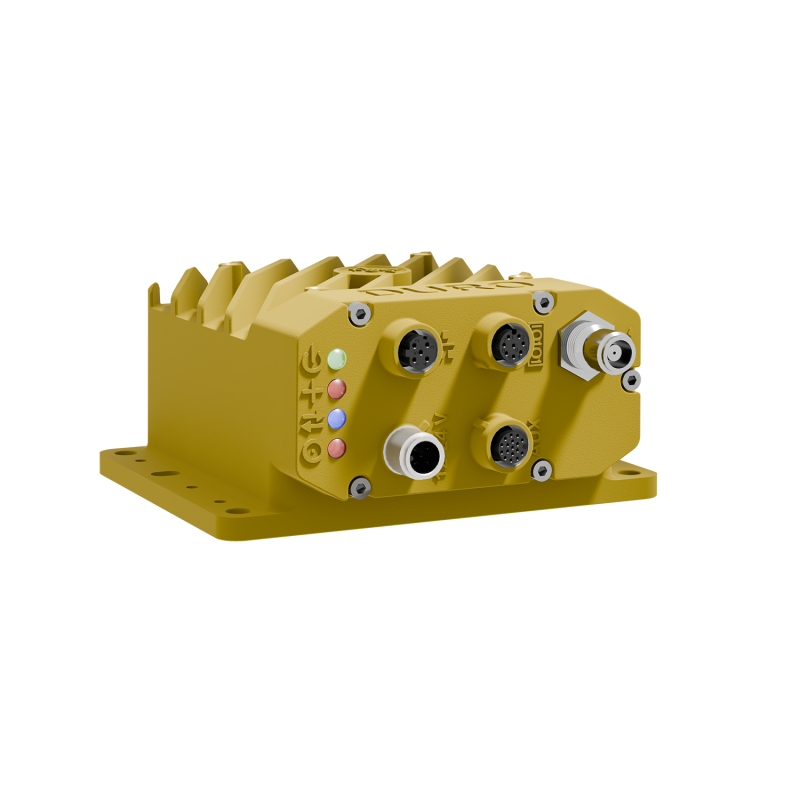

An industrial satellite and inertial navigation device for robotics, vehicle and automated systems. A dual-frequency RTK GNSS receiver and integrated MEMS IMU support precise position and motion measurement, while the rugged IP67 enclosure is designed for extended outdoor deployment.
An industrial satellite and inertial navigation device for robotics, vehicle and automated systems. A dual-frequency RTK GNSS receiver and integrated MEMS IMU support precise position and motion measurement, while the rugged IP67 enclosure is designed for extended outdoor deployment.
Guarantee
24 month
Delivery from Europe in
10 - 15
business days
Carnegie Robotics Duro combines a Piksi Multi GNSS receiver, RTK technology and inertial measurements. It is designed for integration into systems requiring reliable position and motion data, including mobile robots, autonomous platforms, construction machinery and transportation equipment.
Support for multiple frequencies and satellite constellations helps achieve an accurate position solution more quickly and improves measurement availability. With RTK corrections and suitable reception conditions, the device can deliver centimeter-level positioning. This benefits applications requiring repeatable movement and precise machine control.
Measurements from the integrated MEMS IMU are combined with satellite data. Inertial navigation allows positioning to continue through brief GNSS outages, such as when passing obstacles that obstruct satellite signals.
Achievable accuracy depends on the environment, device configuration and outage duration. The manufacturer also offers pose filters optimized for rail and marine applications; the appropriate filter should be selected for the intended application. www.carnegierobotics.com
The cast aluminum enclosure with protective powder coating is designed for industrial environments. Passive thermal management and a wide operating temperature range support operation in varied outdoor conditions.
IP67 protection provides resistance to dust and temporary immersion in water up to 1 meter deep for 30 minutes. This protection requires connectors to be correctly mated or fitted with their sealing caps.
Ethernet and RS232 interfaces connect Duro to a control computer or other integration equipment. Industry-standard M12 connectors simplify industrial cable selection, while status LEDs help monitor operation.
The device supports SBP and NMEA 0183 navigation data, RTCM corrections and an NTRIP client for receiving corrections over the internet. Swift Console provides configuration and operational monitoring. Firmware can be updated through Ethernet or a serial interface. www.carnegierobotics.com
| Parameter | Value |
|---|---|
| Manufacturer | Carnegie Robotics |
| Model | Duro |
| Navigation technology | RTK GNSS and INS |
| GNSS receiver | Piksi Multi, dual-frequency |
| Inertial module | Integrated MEMS IMU |
| Satellite signals | GPS L1/L2, GLONASS G1/G2, BeiDou B1/B2, Galileo E1/E5b |
| SBAS systems | EGNOS, WAAS, GAGAN, MSAS |
| Position update rate | Up to 10 Hz |
| Interfaces | Ethernet, RS232, auxiliary inputs and outputs |
| GNSS antenna connector | TNC |
| Power supply | 10–35 V DC |
| Nominal power consumption | 5 W |
| Operating temperature | −40 to +75 °C |
| Ingress protection | IP67 |
| Enclosure | Cast aluminum |
A suitable external GNSS antenna, power supply and connection cables are required. Centimeter-level RTK operation requires a correction source and suitable signal reception conditions. Antenna placement and installation must follow the manufacturer's recommendations.