


Guarantee
24 month
Delivery from Lithuania in
3 - 5
business days
The omnidirectional vision system only assists flight safety under certain conditions and is not a substitute for your own judgment and control. During a flight, always pay attention to the surrounding environment and the warnings on the DJI Fly app, and be responsible for and maintain control of the drone at all times. When GNSS signals are unavailable, the optimal positioning altitude range for using the vision positioning system is 0.5 to 30 m. The vision positioning performance may decrease when flying beyond this range. Fly with caution. The vision system may not function properly when the drone is flying over water, which may prevent it from actively avoiding water surfaces below when landing. Operators should maintain control of the drone at all times, make operational decisions based on an assessment of the surrounding environment, and avoid relying solely on the vision system. The vision system cannot detect certain objects or surfaces, including large structures with frames and cables (e.g., tower cranes, high-voltage transmission towers, high-voltage transmission lines, cable-stayed bridges); surfaces with no texture or sparse texture; surfaces with repetitive identical patterns or textures (e.g., small tiles of the same color); solid-colored surfaces (e.g., pure black, pure white, pure red, pure green); strongly reflective or mirrored surfaces (e.g., ice, road signs); water or transparent surfaces; surfaces of moving objects (e.g., above moving crowds, above waving shrubs or grass); moving obstacles (e.g., walking people, moving vehicles); scenes with drastic lighting changes; surfaces that are extremely dark (e.g., less than 1 lux) or extremely bright (e.g., more than 100,000 lux); materials with strong infrared absorption or reflection properties (e.g., mirrors, glass, road signs, asphalt); small obstacles (e.g., fences, branches, power lines); and thin poles or small vertical objects (e.g., utility poles, street lamps). Do not obstruct or interfere with the sensing system under any circumstances. Ensure that all lenses remain clear, free from dirt, smudges, or other contaminants, and are not scratched. Vision system cameras may need to be calibrated after being stored for an extended period. A prompt will appear in the DJI Fly app and calibration will be performed automatically. Do not fly when it is rainy, smoggy, or the visibility is lower than 100 m. Before takeoff, inspect the sensing system's glass surfaces. Remove any protective film, stickers, or other obstructions. If water droplets, fingerprints, or smudges are present, clean the glass using a lint-free cloth. Do not use alcohol or other organic solvents. If the glass surface is loose, broken, scratched, or worn, send the drone to an authorized service center for repair. Refer to the product's user manual for more details.
The omnidirectional vision system only assists flight safety under certain conditions and is not a substitute for your own judgment and control. During a flight, always pay attention to the surrounding environment and the warnings on the DJI Fly app, and be responsible for and maintain control of the drone at all times. When GNSS signals are unavailable, the optimal positioning altitude range for using the vision positioning system is 0.5 to 30 m. The vision positioning performance may decrease when flying beyond this range. Fly with caution. The vision system may not function properly when the drone is flying over water, which may prevent it from actively avoiding water surfaces below when landing. Operators should maintain control of the drone at all times, make operational decisions based on an assessment of the surrounding environment, and avoid relying solely on the vision system. The vision system cannot detect certain objects or surfaces, including large structures with frames and cables (e.g., tower cranes, high-voltage transmission towers, high-voltage transmission lines, cable-stayed bridges); surfaces with no texture or sparse texture; surfaces with repetitive identical patterns or textures (e.g., small tiles of the same color); solid-colored surfaces (e.g., pure black, pure white, pure red, pure green); strongly reflective or mirrored surfaces (e.g., ice, road signs); water or transparent surfaces; surfaces of moving objects (e.g., above moving crowds, above waving shrubs or grass); moving obstacles (e.g., walking people, moving vehicles); scenes with drastic lighting changes; surfaces that are extremely dark (e.g., less than 1 lux) or extremely bright (e.g., more than 100,000 lux); materials with strong infrared absorption or reflection properties (e.g., mirrors, glass, road signs, asphalt); small obstacles (e.g., fences, branches, power lines); and thin poles or small vertical objects (e.g., utility poles, street lamps). Do not obstruct or interfere with the sensing system under any circumstances. Ensure that all lenses remain clear, free from dirt, smudges, or other contaminants, and are not scratched. Vision system cameras may need to be calibrated after being stored for an extended period. A prompt will appear in the DJI Fly app and calibration will be performed automatically. Do not fly when it is rainy, smoggy, or the visibility is lower than 100 m. Before takeoff, inspect the sensing system's glass surfaces. Remove any protective film, stickers, or other obstructions. If water droplets, fingerprints, or smudges are present, clean the glass using a lint-free cloth. Do not use alcohol or other organic solvents. If the glass surface is loose, broken, scratched, or worn, send the drone to an authorized service center for repair. Refer to the product's user manual for more details.
2. ActiveTrack can work properly only when certain flight conditions are met. See Footnote 1 to ensure the omnidirectional vision system is normal and avoid flying in the following environments or conditions: DO NOT fly in severe weather conditions, such as in strong winds (wind speed of more than 10.7 m/s), snow, rain, lightning, or fog. DO NOT fly the drone 4500 m or higher above sea level. DO NOT fly the drone in environments where the temperature is below 0° C (32° F) or above 40° C (104° F). DO NOT take off from moving objects, such as cars or boats. DO NOT fly close to reflective surfaces such as water or snow. Otherwise, the vision system may not work correctly. The vision system may not work properly in dim environments. Always fly with caution and prevent the drone from entering Attitude mode. DO NOT fly near areas with magnetic or radio interference. Common magnetic or radio interference sources include Wi-Fi hotspots, routers, Bluetooth devices, high-voltage lines, large-scale power transmission stations, radar stations, mobile base stations, and broadcasting towers. Avoid sand entering the drone when taking off in desert or beach areas. Fly the drone in open areas away from crowds. Buildings, mountains, and trees may block the GNSS signal and affect the onboard compass.
Standard video recording supports up to 4K/60fps, and slow-motion video recording supports up to 4K/100fps.
Photo resolution can reach up to 8K (48 MP). When the resolution is 8K (48 MP), SmartPhoto is unavailable. When the resolution is 4K (12 MP), SmartPhoto can be automatically enabled to apply algorithmic beautification.
The actual product weight may vary due to differences in batch materials and external factors. Training or examination is not required for flying this product in most countries and regions. With the Intelligent Flight Battery Plus, the aircraft will weigh more than 249 g. Always check local laws and regulations before use.
Using the Intelligent Flight Battery, the maximum flight time is 36 minutes. This is measured in a controlled wind tunnel environment under conditions equivalent to windless operation and sea-level altitude, with the drone flying forward at a constant speed of 21.6 kph, Obstacle Avoidance Action set to Brake and in photo mode, until forced landing due to battery depletion. The Intelligent Flight Battery Plus extends the flight time to 52 minutes when flying forward at a constant speed of 21.6 kph. However, the Intelligent Flight Battery Plus is not included in the combo. If needed, purchase it separately. Please note that the Intelligent Flight Battery Plus is not supported by this product in the EU or the UK. Always comply with local laws and regulations before flying.
Measured in an open outdoor environment without interference and with IC compliance. The above data shows the farthest communication range for one-way, non-return flights. Always pay attention to RTH reminders in the DJI Fly app during your flight.
| Antennas quantity | 2 |
| Battery | Lithium-Ion rechargeable |
| Battery capacity | 18.96 Wh, 2590 mAh |
| Battery operated | Yes |
| Battery technology | Lithium-Ion (Li-Ion) |
| Battery voltage | 7.32 V |
| Battery weight | 79 g |
| Bitrate at maximum video resolution | 130 Mbit/s |
| Bluetooth | Yes |
| Bluetooth version | 5.4 |
| Built-in camera | Yes |
| Cables included | RC |
| Camera shutter speed | 1/8000-2 s |
| Carrying case | Yes |
| Compatible memory cards | MicroSDXC |
| Depth | 183 mm |
| Easy to use | Yes |
| Field of view (FOV) angle | 79 ° |
| Foldable | Yes |
| Gimbal protector | Yes |
| GPS (satellite) | Yes |
| Height | 79 mm |
| Image formats supported | JPEG/Raw |
| Lowest latency | 120 ms |
| Maximum aperture number | 1.8 |
| Maximum ascent speed | 7 m/s |
| Maximum control speed (tilt) | 100 °/sec |
| Maximum descent speed | 7 m/s |
| Maximum flight altitude | 4500 m |
| Maximum flight time | 36 min |
| Maximum frame rate | 60 fps |
| Maximum memory card size | 1000 GB |
| Maximum operating distance | 20000 m |
| Maximum pitch angular velocity | 35 °/sec |
| Maximum video resolution | 3840 x 2160 pixels |
| Maximum wind resistance | 10.7 m/s |
| Mechanical pan range | -30 - 30 ° |
| Mechanical roll range | -49 - 49 ° |
| Mechanical tilt range | -126 - 67 ° |
| Megapixel (approx.) | 48 MP |
| Memory card slot(s) | Yes |
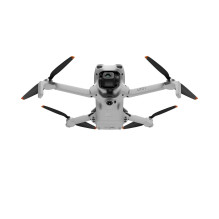
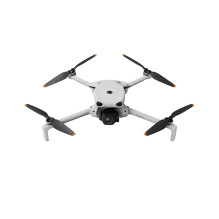
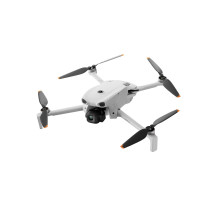
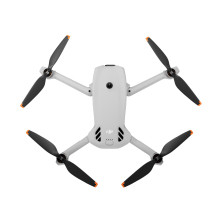
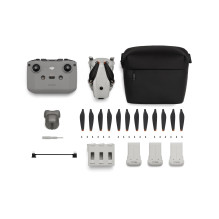
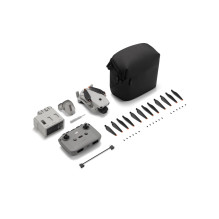
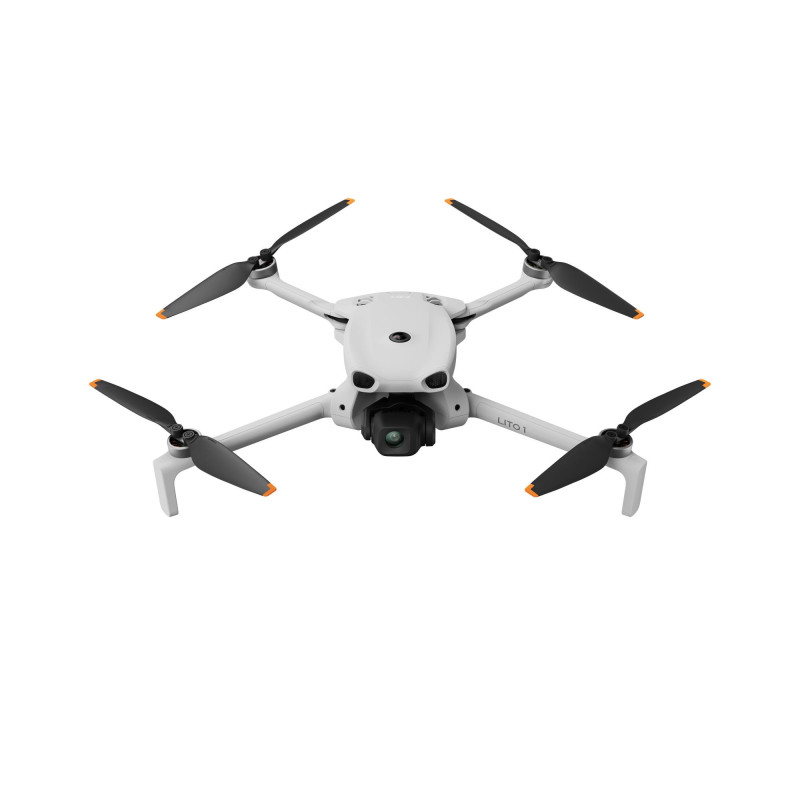
| Model name | Lito 1 Fly More Combo |
| Moving control functions | Backward/Downward/Forward/Lateral/Upward |
| Number of propeller blades | 2 |
| Number of rotors | 4 rotors |
| Operating temperature (T-T) | 0 - 40 °C |
| Optical sensor size | 1/2 " |
| Product colour | Grey |
| Product Net Weight | 0.249 kg |
| Remote control included | Yes |
| Screwdriver included | Yes |
| Sensor type | CMOS |
| Shipping Box Depth | 58.5 cm |
| Shipping Box Height | 25 cm |
| Shipping Box Weight | 6.5500001907 kg |
| Shipping Box Width | 29.5 cm |
| Summary | DJI Lito 1 Fly More Combo. Number of rotors: 4 rotors. Megapixel (approx.): 48 MP, Maximum video resolution: 3840 x 2160 pixels. Maximum operating distance: 20000 m. Moving control functions: Backward, Lateral, Upward, Downward, Forward. Battery technology: Lithium-Ion (Li-Ion), Battery capacity: 2590 mAh. Compatible memory cards: MicroSDXC. Wi-Fi, Wi-Fi standards: Wi-Fi 6 (802.11ax), 802.11a, 802.11b, 802.11g, Wi-Fi 4 (802.11n), Wi-Fi 5 (802.11ac), Bluetooth, Bluetooth version: 5.4. Product colour: Grey |
| Type | Quadcopter |
| Unit Box Height | 0.19 |
| Unit Box Length | 0.135 |
| Unit Box Width | 0.24 |
| Unit Calculated Volume | 0.01079 cubm |
| Unit Calculated Weight | 1.64 kg |
| Units per Shipping Box | 4 |
| Vendor Homepage | https://www.dji.com/uk |
| Video formats supported | AVC/H.264/HEVC/H.265/MP4/MPEG4 |
| Video resolutions | 1920 x 1080/3840 x 2160 pixels |
| Weight | 249 g |
| Wi-Fi | Yes |
| Wi-Fi standards | 802.11a/802.11b/802.11g/Wi-Fi 4 (802.11n)/Wi-Fi 5 (802.11ac)/Wi-Fi 6 (802.11ax) |
| Width | 251 mm |