
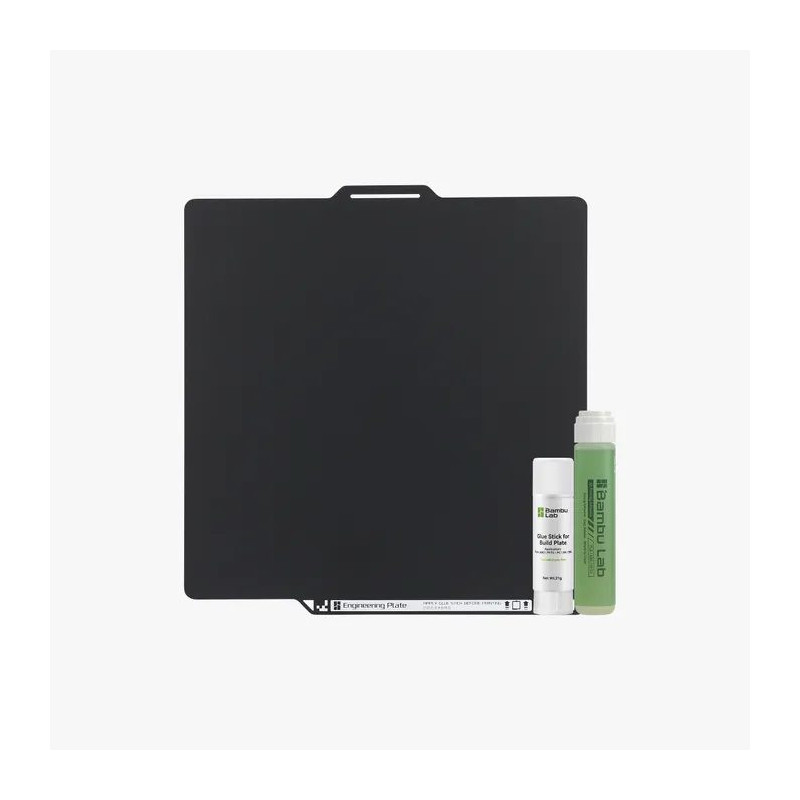

Bambu Engineering board P2S / Engineering board + glue
Product reference: 14-952724082406

Optimized for high-temperature filaments
Compatible with all types of threads
Built for long-term performance

Bambu Engineering board P2S / Engineering board + glue

Product reference: 14-952724082406

Optimized for high-temperature filaments
Compatible with all types of threads
Built for long-term performance

You have 3 products in compare list, please remove someone and try again
  • Add to favorites products
  • Added to favorites products
  • Removed to favorites product
Add to compare
78,85
Last product in warehouse

Guarantee
24 month

Delivery from Lithuania in
2 - 3
business days

Your message has been successfully sent!
Fill in the required fields*

One build plate for all filaments


Using a simple layer of adhesive, the engineered board is compatible with all of our filaments, making it a great solution when you're not sure which board to use.


Durable smooth surface coating


The updated coating significantly improves the board's resistance to temperature, scratches, and corrosion. Designed to withstand long-term high-temperature printing and hundreds of washes and peels, its smooth, reliable surface guarantees a stable grip every time.


Smooth and natural surface finish


A smooth basecoat can provide a smooth and flat texture on the bottom surface of the printed object, blending better with other parts of the surface.


Considerations


  1. Before printing with any filament, it is recommended to apply glue to the engineering board. Using solid glue can make it easier to remove parts, but because solid glue has a certain thickness and is difficult to apply evenly, the printing stability and first layer quality are usually worse than using liquid glue. On the other hand, liquid glue can make it difficult to remove parts. You should choose the right type of glue based on the filament, printing environment, and other practical conditions. For more information, please visit the official wiki: Bambu Lab Wiki.

  2. When using a scraper to remove prints, it is important to use the correct technique. If the model sticks too much to the build plate, apply alcohol to the interface between the model and the plate to reduce adhesion and make removal easier. This helps prevent damage to the model, build plate, or possible injury from using excessive force.

  3. Increasing the temperature of the heated plate improves adhesion. Users should adjust the temperature of the heated plate according to their specific requirements to achieve the most suitable adhesion level.

  4. For X1 series, P1 series and A1 printers, it is necessary to repeatedly rub the nozzle in the cleaning area on the build plate before auto-alignment to completely remove the remaining material at the end of the nozzle. The coating in the cleaning area will gradually wear off over time, which is normal and does not affect the print quality or the longevity of the nozzle, so there is no need to worry about quality issues.

  5. Dust and grease deposits on the build plate can reduce adhesion. It is recommended to clean the build plate regularly with warm water and dishwashing detergent to maintain optimal adhesion. Do not use other non-approved cleaning agents.

  6. Bambu Lab recommends using only official Bambu Lab adhesives on Bambu Lab building boards and cannot be held responsible for any damage resulting from the use of third party adhesives on building boards. Do not use acetone to clean the engineering board as this will damage the surface of the engineering board.

  7. Always wait a few minutes before removing printed models to allow the board to cool and make it easier to remove prints. This helps prevent damage to the board and ensures a longer product life.

  8. The latest software significantly improves the calibration of the Bambu engineering board using Micro Lidar, and it is now fully compatible with the automatic calibration process.

  9. The engineered board is considered a consumable component that deteriorates over time. The warranty will only cover manufacturing defects and not cosmetic damage such as scratches, dents or cracks. Only defective boards that arrive on site are warranted.


Recommended settings


Please note that other cutting settings may need to be adjusted depending on the model being printed and filament requirements.


Materials Heated plate temperature Need glue?
PLA/PLA-CF/PLA-GF 45~60 Glue stick/Liquid glue
PETG/PETG-CF 60~80 Glue stick/Liquid glue
ABS (not A1 mini) 90~100 Glue stick/Liquid glue
ASA (not A1 mini) 90~100 Glue stick/Liquid glue
TPU 35~45 Glue stick/Liquid glue
PVA 45~60 Glue stick/Liquid glue
PC/PC-CF (not A1 mini) 90~110 Glue stick/Liquid glue
PA/PA-CF/PAHT-CF (not A1 mini) 90~110 Glue stick/Liquid glue
PET-CF (not A1 mini) 80~100 Glue stick/Liquid glue

Product specifications


Material Polyester powder + manganese steel
Surface temperature resistance Up to 120
Thickness 0.5mm
Print size used X1C/P1P/P1S/A1/P2S/X2D - 256*256mm
H2D/H2S - 350*320mm
H2C/A2L - 330*320mm
Packing size X1C/P1P/P1S/A1/P2S/X2D - 315*295*15mm
H2D/H2S - 393mm*380mm*15mm
H2C/A2L - 393mm*380mm*15mm
Packing weight X1C/P1P/P1S/A1/P2S/X2D - 0.50kg
H2D/H2S - 0.78kg
H2C/A2L - 0.78kg

Height20 mm
Length320mm
Weight650g
Width300mm
Offensive and promotional comments are unpublished.
Testimonials not found!
Testimonial