



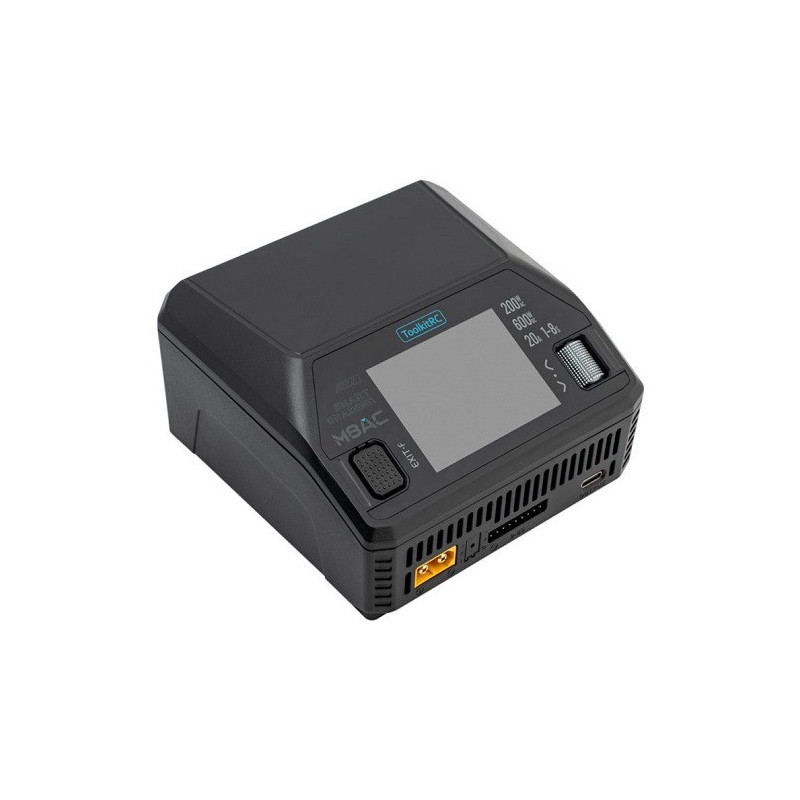

The M8AC Smart Battery Charger is a versatile tool for charging, discharging and balancing various battery types, including LiPo, NiMH and lead-acid. It features a 200W AC power supply, a USB Type-C fast charging port and a 2.4-inch color display for convenient control and diagnostics.
The M8AC Smart Battery Charger is a versatile tool for charging, discharging and balancing various battery types, including LiPo, NiMH and lead-acid. It features a 200W AC power supply, a USB Type-C fast charging port and a 2.4-inch color display for convenient control and diagnostics.
Guarantee
24 month
Delivery from Europe in
4 - 5
business days
The M8AC Smart Battery Charger is a multi-functional device that charges, discharges and balances various battery types, including LiPo, NiMH and lead acid. It features a 200W AC power supply, a USB Type-C fast charging port and a 2.4-inch color display for easy operation and diagnostics.
Features | |
|---|---|
| Product Type | Smart Battery Charger |
| Supported Battery Types | LiPo, LiHV, LiFe, Li-ion, LTO, NiMH, NiCd, Pb (lead acid) |
| Charging Modes | Charging, Discharging, Balancing |
Specifications | |
| Input Voltage | 100-240V AC, 7-35V DC |
| Maximum Input Current | AC: 2.5A, DC: 25A |
| Charging Current Range | 0.1-20.0A |
| Maximum Charging Capacity | 200W (AC), 600W (DC) |
| Maximum Discharge Capacity | 20 W (0.1-3.0 A), 600 W (recycle mode) |
| Balancing Current | 1000mA @ 4.2V |
| Adjustable Voltage | 1.0-35.0V |
| Adjustable Current | 1.0-20.0 A |
| Internal Resistance Measurement | 0.1-99 mOhm |
| Screen | 2.4" IPS LCD (320 x 240) |
| Operating Temperature | 0-40°C |
| Dimensions | 108 x 113 x 62 mm |
| Weight | 490g |
Additional Information | |
| Connectors | DC input, AC input, Signal port (PWM/PPM/SBUS), Balance port (2-8 S), XT60 output, USB Type-C output |
| USB Type-C Output | Max 20.0 V @ 65 W |
| Security Features | Over voltage, Over current, Short circuit, Reverse polarity, Overheating, Low input voltage, Time limit, Shutdown |
| Safety Warning | Use the product only for its intended purpose to avoid hazards. |